Best Cheap 3D Printer Filament Under $20/kg (Honest Picks)
The cheapest spool on the page is rarely the cheapest to print. Here's where budget filament is genuinely fine — and where saving five dollars costs you a weekend.
Try these in order (cheapest first)
- Buy budget PLA from a reputable maker (eSUN, Overture, Sunlu, Inland, Hatchbox) — $13–$20/kg
- Choose by diameter tolerance — aim for ±0.02–0.03mm — —
- Step up to budget PETG only when you need heat or toughness — $16–$22/kg
- Don't cheap out on TPU, ASA, or structural specialty filament — —
- Vet a cheap spool — weight, winding, and reviews — before trusting it — Free
- Cut cost with multipacks, sales, and refill (no-spool) options — Saves $2–$6/kg
Step by step
Step 1: Start with budget PLA from a reputable maker
For everyday printing, budget PLA from an established brand is the sweet spot — and it already lives under $20/kg. Names like eSUN, Overture, Sunlu, Hatchbox, and Micro Center's Inland line sell PLA in the roughly $13–20/kg range that prints cleanly out of the box, with tight enough diameter control that you don't fight clogs and gaps. These aren't premium prices for premium plastic; they're the mainstream budget tier, and they're where most hobbyists should buy. PLA is the easiest material to print, needs no enclosure, and covers the large majority of prints people actually make.
Step 2: Choose by diameter tolerance, not just price
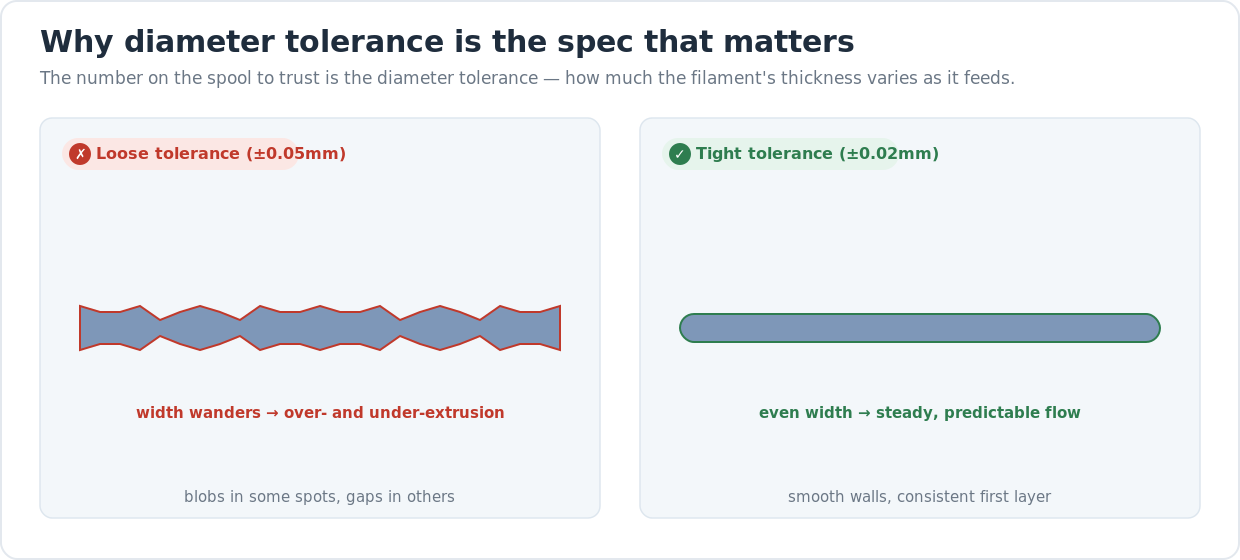
The one spec worth reading is the diameter tolerance — how much the filament's thickness varies as it feeds. Reputable budget spools list something like 1.75mm ±0.02mm or ±0.03mm. The cheapest no-name spools either don't state it or quote a loose ±0.05mm, and that variation shows up as over-extrusion where the strand is fat and under-extrusion where it's thin — blobs in some spots, gaps in others. A consistent diameter feeds predictably, gives smooth walls and a steady first layer, and is the single biggest difference between a spool that prints and one that frustrates you.
Step 3: Step up to budget PETG only when you need it
If a part needs more heat resistance or toughness than PLA — outdoor brackets, things that sit in a hot car, parts that flex without snapping — budget PETG from the same reputable brands runs a little more, roughly $16–22/kg, and is worth it for those jobs. Don't default to it, though: PETG is stringier and fussier to dial in than PLA, and for most indoor prints it's a downgrade in ease for no real benefit. Buy PLA for the bulk of your printing and keep one spool of PETG for the parts that genuinely need it.
Step 4: Don't cheap out where it actually matters
Some filaments aren't worth buying cheap. Bargain TPU (flexible filament) is a common source of misery — loose tolerance and soft plastic jam in the extruder, so a known-good brand earns its price here. ASA and polycarbonate are demanding enough that a cheap, poorly-dried spool wastes the enclosure time they require. And for anything structural or safety-related, the few dollars saved on mystery filament isn't worth a part that fails under load. Cheap PLA for prototypes and trinkets: yes. Cheap specialty or load-bearing filament: rarely.
Step 5: Vet a cheap spool before you trust it
Before you buy a bargain spool in bulk, do three free checks. Read recent reviews specifically for tangling and diameter complaints — those are the failure modes that waste filament. Confirm the listing states a real diameter tolerance; silence usually means it's loose. And when it arrives, weigh it: a "1kg" spool should hold about 1kg of plastic, not 1kg including a heavy cardboard core. A clean, evenly-wound spool that lists a tight tolerance and weighs out honestly is usually fine, whatever the brand. One that fails these tells will cost you more in failed prints than it saved.
Step 6: Cut cost with multipacks, sales, and refills
You can push reliable filament well under $20/kg without dropping to no-name plastic. Multipacks (4–10 spools) from reputable brands routinely work out to $13–16/kg. Seasonal sales on established brands beat the everyday price of mystery filament. And refills — the no-spool "just the coil" option several brands now sell — knock a couple of dollars off each kg and cut waste if you keep one empty spool or a reusable holder. These tactics get you brand-name consistency at no-name prices, which is the actual goal: cheap filament that still prints.
Frequently asked questions
- Is cheap 3D printer filament bad?
- Not inherently. Budget PLA from reputable brands like eSUN, Overture, or Inland prints reliably and already costs under $20/kg. What's bad is the cheapest no-name plastic with loose or unstated diameter tolerance and tangled winding — it causes clogs, gaps, and failed prints that waste more filament than you saved. Cheap and reliable is easy to find; cheapest-possible is usually a false economy.
- What is a good price for PLA filament per kg?
- Reliable budget PLA runs roughly $13–20 per kg from established brands, and multipacks or sales push it toward $13–16. Much below that and you're usually buying loose-tolerance, poorly-wound plastic that costs more in failed prints. Much above $25–30/kg buys specialty colours, finishes, or premium brands you don't need for everyday printing. The $13–20 range is the sweet spot for everyday PLA.
- Does more expensive filament actually print better?
- Up to the reputable budget tier, yes — paying $15 instead of $9 buys tighter diameter control and cleaner winding that prevent failures. Beyond that, extra money mostly buys colours, finishes, and brand premium, not better printing. A $30 spool doesn't print meaningfully better than a $17 spool of the same material from a solid brand. Spend enough to clear the no-name tier, then stop.
- What is filament diameter tolerance and why does it matter?
- Diameter tolerance is how much the filament's thickness varies as it feeds, written like ±0.02mm. It matters because your printer assumes a constant diameter — when the strand is fatter it over-extrudes, and when it's thinner it under-extrudes, giving blobs in some spots and gaps in others. Aim for ±0.02–0.03mm; a loose ±0.05mm or an unstated tolerance is the mark of bargain filament that will frustrate you.
- Are no-name Amazon filaments safe to use?
- Some are fine and some aren't, and the listing rarely tells you which. The risk isn't safety so much as reliability — loose diameter tolerance, tangled winding, and brittle plastic cause clogs and failed prints. If you try one, check reviews for tangling complaints, confirm it lists a real diameter tolerance, and weigh the spool on arrival. When in doubt, a known budget brand for a couple of dollars more removes the gamble.
- What is the cheapest reliable 3D printer filament?
- Budget PLA from eSUN, Overture, Sunlu, Hatchbox, or Micro Center's Inland line is the cheapest filament most people can trust, typically $13–20/kg and less in multipacks. They sit in the mainstream budget tier — cheap enough for everyday printing, consistent enough to avoid the clogs and failures that plague no-name spools. For the lowest reliable cost, buy one of these in a multipack or on sale.
The cheapest spool is rarely the cheapest to print
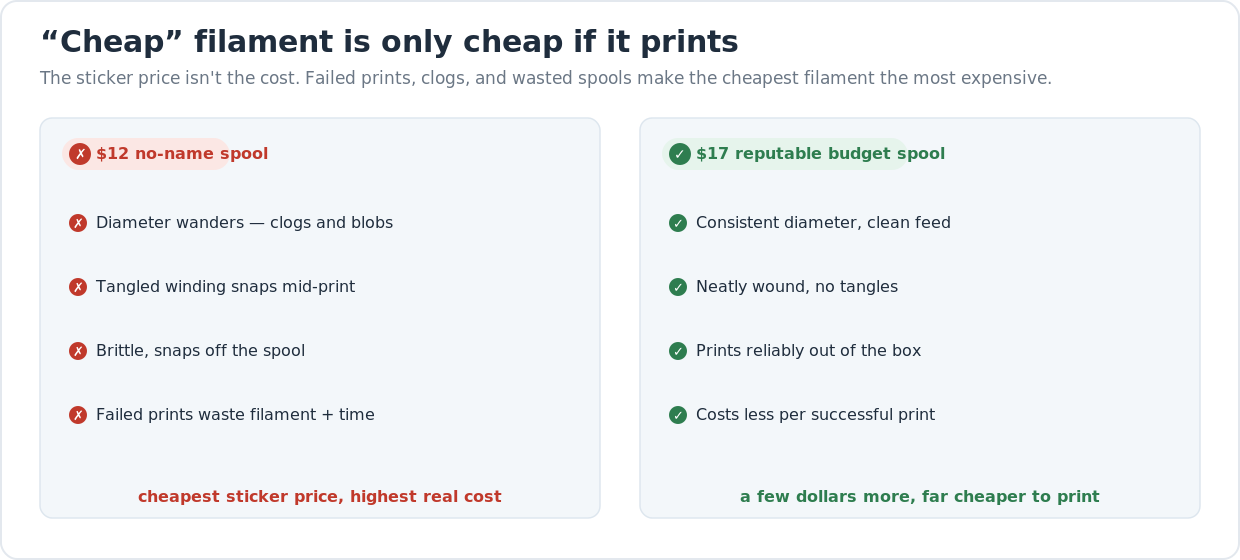
Filament under $20/kg is easy to find. Filament under $20/kg that doesn’t waste your evening is the actual goal — and the two aren’t the same. The hero diagram lays out the trap: a $12 no-name spool with a wandering diameter, tangled winding, and brittle plastic looks like the bargain, but the clogs, mid-print snaps, and failed prints it causes burn through more filament and far more time than the $17 spool that simply works. Cheap only counts if it prints.
The good news is you don’t have to choose between cheap and reliable. The mainstream budget brands already sit under $20/kg, and with multipacks and sales they drop well below it. This guide is about buying in that tier on purpose — getting brand-name consistency at no-name prices — instead of chasing the lowest sticker and paying for it later.
Read the tolerance, not the marketing
The one number that separates good budget filament from bad is the diameter tolerance. A consistent strand feeds predictably and lays smooth walls; a strand that bulges and necks over- and under-extrudes its way to blobs and gaps. Reputable budget brands publish a tight figure (±0.02–0.03mm); bargain spools leave it off or quote a loose ±0.05mm. If a wandering diameter is starving or flooding your extruder, the symptoms look exactly like under-extrusion — gappy walls and weak infill — except no setting change fixes it, because the filament itself is the problem.
Match the material to the job
Cheap PLA covers most printing, but it isn’t the answer for everything. Before you buy, decide what the part has to survive. Our PLA vs PETG vs ABS comparison breaks down which plastic suits which job, and for anything living outdoors, the best filament for outdoor use explains why a cheap PLA spool is a false economy in the sun. Buying the right material cheaply beats buying the wrong material at any price.
Store it right or the savings evaporate
A bargain spool you let absorb moisture prints worse than a premium spool kept dry. PLA and especially PETG pull water from the air, and wet filament hisses, strings, and bonds weakly — undoing every dollar you saved. Keep open spools in a sealed box with desiccant, and if a cheap spool has been sitting out, our guide to drying filament brings it back before you blame the brand. And if you’re still choosing the printer that will eat all this filament, the honest desktop 3D printer buyer’s guide covers which budget machines are easy on filament and which waste it.
Affiliate and pricing note
Prices here are typical street ranges as of mid-2026 and move with sales and supply — always check the current listing before you buy. We name brands by reputation in the budget tier, not by paid placement, and we don’t rewrite a recommendation for a commission. If a link on this site is an affiliate link, the disclosure below makes that clear.
Last updated
Reviewed 2026-06-30. Brand availability and pricing vary by region — eSUN, Overture, Sunlu, and Hatchbox are widely available internationally, while Micro Center’s Inland line is US-only. The $13–20/kg figures are US street prices for 1kg PLA spools; adjust for your market and for sales.