PLA vs PETG vs ABS vs PLA+: Which Filament Should You Actually Use?
The honest breakdown — what each material is good at, where it fails, and the one-question shortcut that gets most people to the right answer first.
Try these in order (cheapest first)
- Start with PLA — it prints the easiest and covers most indoor, low-stress parts — $18–$30/kg
- Move to PETG for outdoor, high-temp (car interior), or food-contact parts — $20–$35/kg
- Use ABS only if you need high impact resistance AND have an enclosure — $18–$28/kg
- Consider PLA+ for tall or thin prints where layer adhesion matters — $22–$35/kg
Step by step
Step 1: PLA — use this unless you have a specific reason not to
PLA is the go-to for indoor parts, decorative prints, prototypes, and anything that doesn't need to survive heat above roughly 50–60°C. It prints at 190–220°C, sticks well to a clean PEI bed at 55–65°C, and rarely warps. No enclosure required. It's brittle in thin sections (snaps cleanly rather than bending), which matters for snap-fit clips or thin-walled living hinges — use PETG or TPU for those. PLA is not UV-stable; outdoor parts exposed to direct sun will become brittle and fade in 6–18 months depending on the climate.
Step 2: PETG — the default for outdoor, heat-exposed, or slightly flexible parts
PETG's heat deflection temperature (roughly 70–80°C under load, depending on brand) makes it the natural choice for anything that lives in a car interior, a garden, or near a heat source. It's tougher than PLA — it bends before it snaps — which makes it better for brackets, clips, and parts that take repeated light impact. PETG also has better chemical resistance than PLA and is generally considered food-safe (check your specific brand's certification). The downsides: it strings more than PLA, bonds aggressively to PEI sheets if over-heated (a light adhesion barrier like a thin layer of glue stick prevents tearing), and its dimensional accuracy is slightly lower than PLA due to higher thermal expansion.
Step 3: ABS — only if you need it, and only with an enclosure
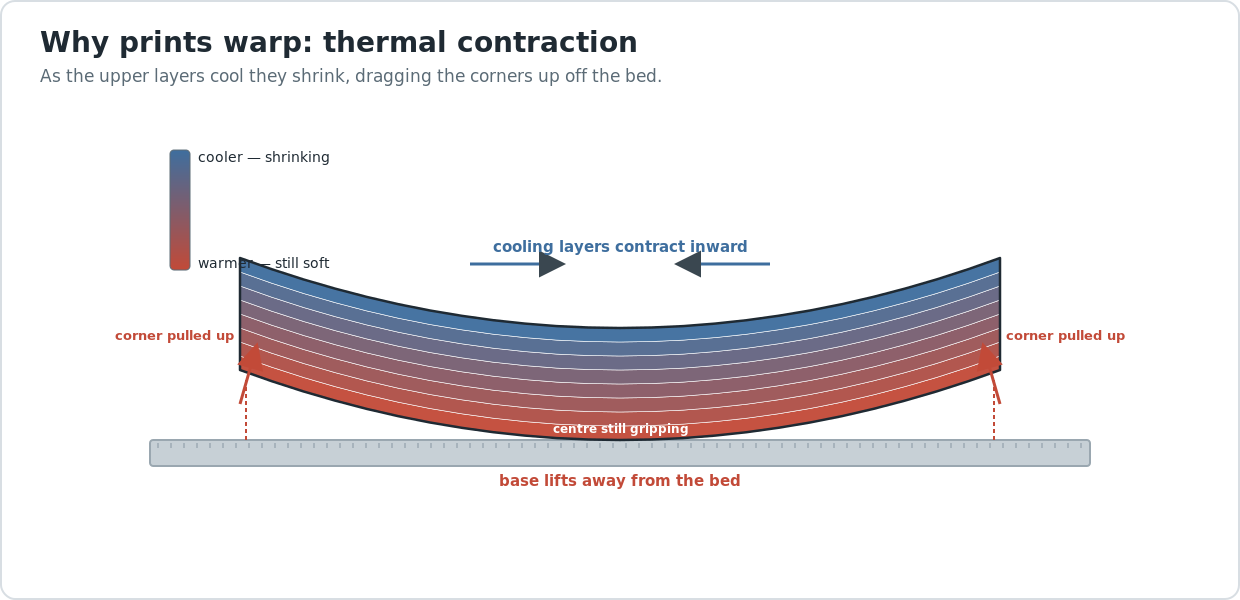
ABS has higher impact resistance than PLA or PETG and tolerates heat up to roughly 90–100°C under load. It's also acetone-smoothable — you can chemically weld ABS parts and smooth surface roughness with an acetone vapor chamber. The trade-offs are real: ABS warps significantly without a heated enclosure, the fumes are unpleasant and should not be inhaled in an enclosed space without filtration, and it's harder to get consistent first layers. For most people, PETG covers 90% of what they'd reach for ABS to do. Choose ABS specifically when you need impact resistance AND acetone finishing, or when you're printing parts that must survive above 80°C.
Step 4: PLA+ — a useful incremental upgrade for specific situations
PLA+ is standard PLA reformulated with additives (typically rubber toughening agents or plasticizers, depending on the brand) to reduce brittleness and improve inter-layer adhesion. It prints almost identically to standard PLA — same temps, no enclosure needed — and behaves better in tall prints where delamination under flex is the failure mode. It costs a bit more. It is not a significant upgrade for flat or short prints where standard PLA already performs well, and its heat resistance is the same as standard PLA (roughly 50–60°C). If you're printing phone cases, clips, or living hinges, PLA+ earns its place. For decorative prints and prototypes, standard PLA is fine.
Frequently asked questions
- Is PETG stronger than PLA?
- Tougher, not necessarily stronger. PETG bends before it snaps; PLA snaps cleanly but can resist higher tensile load before breaking. For parts that take flex and repeated impact, PETG wins. For rigid parts under compression or shear, PLA's dimensional stability often makes it the better choice. "Stronger" depends on the failure mode you're designing against.
- Can I print ABS without an enclosure?
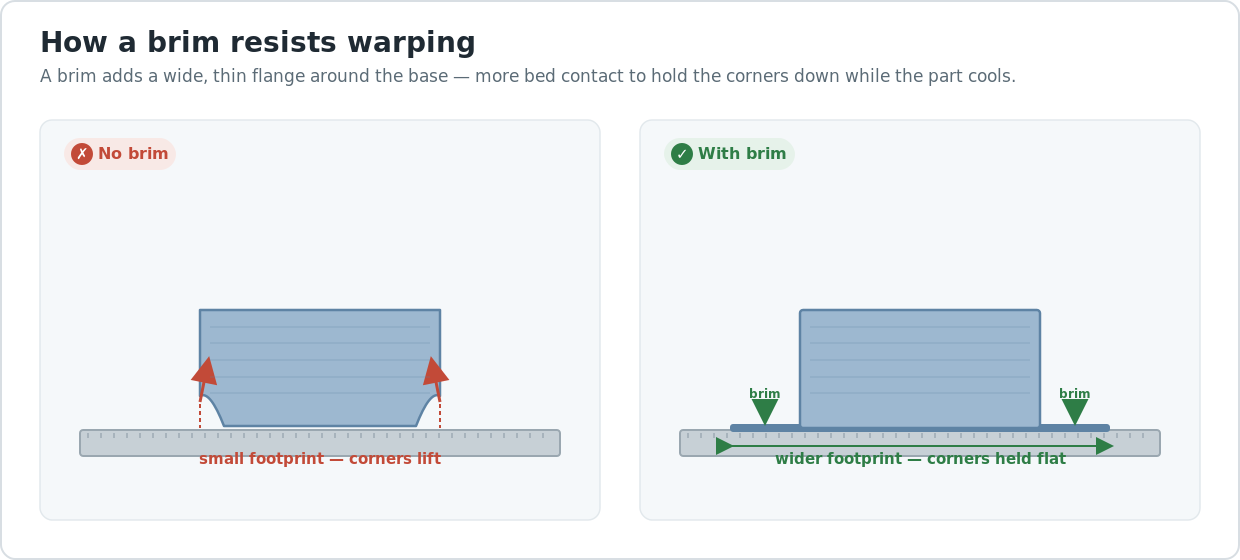
- For small parts (under about 50×50 mm), you can sometimes get away with it by keeping the room warm, eliminating drafts, and using a brim. For anything larger, or for tall prints, you'll fight warping continuously. An enclosure isn't optional for reliable ABS — it's what makes it printable at scale.
- Is PETG food-safe?
- PETG is generally considered food-safe as a material, but FDM-printed PETG parts have micro-gaps between layers that harbor bacteria and are impossible to sanitize completely. For food contact, use your prints only with dry foods, treat them as single-use or short-term, and check your specific filament brand's food-safety certification — not all PETG is certified.
- Why does my PETG stick so hard to the PEI bed that it tears the surface?
- PETG bonds aggressively to bare PEI at high bed temperatures. Apply a thin layer of glue stick (dried, not wet) to the print area before the print — it acts as a release layer. PEI tears when the print is removed cold and the PETG has bonded too tightly; also try removing the print while the bed is still warm (50–60°C) rather than letting it cool fully.
The one-question shortcut
Before reaching for a material comparison table, ask: will this part live outside, in a car interior, or somewhere above 50°C?
- No → PLA. Done.
- Yes, but not above 80°C and no impact requirement → PETG.
- Yes, above 80°C or high impact required → ABS (with an enclosure).
The table below is for the cases where the shortcut doesn’t fully answer the question.
Quick comparison
| PLA | PLA+ | PETG | ABS | |
|---|---|---|---|---|
| Heat resistance | ~50–60°C | ~50–60°C | ~70–80°C | ~90–100°C |
| Ease of printing | Easiest | Easy | Moderate | Hard |
| Enclosure required? | No | No | No | Yes |
| Warping | Low | Low | Low–moderate | High |
| Impact resistance | Low | Moderate | Moderate | High |
| UV stability | Poor | Poor | Moderate | Moderate |
| Acetone smoothable? | No | No | No | Yes |
| Typical price/kg | $18–$30 | $22–$35 | $20–$35 | $18–$28 |
Heat resistance figures are approximate heat deflection temperatures under light load; actual values vary by brand, color, and print settings.
What about TPU, ASA, and other materials?
TPU (flexible filament) is its own category — use it for phone cases, gaskets, wheels, and anything that needs to bend and spring back. ASA is ABS with better UV stability — it’s the right pick for outdoor parts that must also take impact. Nylon offers exceptional toughness and wear resistance but requires dry storage and careful printing. All three are worth knowing about; none of them replace the PLA→PETG→ABS progression for most users.
If you’re shopping for your first spool beyond what came with the printer, see our honest desktop 3D printer buyer’s guide for which printers handle multi-material best.
Last updated
Reviewed 2026-06-23. Temperature ranges are material-category averages; always check your specific filament brand’s technical data sheet.